Understand
Why brutalism is beautiful: the ambition behind the concrete
The most photographed buildings of the twentieth century are also its most misjudged, and the two facts are connected. Brutalism reaches almost everyone as an image — a grey slab shot flat under a white sky, streaked with rain, cropped until it reads like a prison wall — and the image is the worst possible witness. Concrete is a material of light, mass and moving shadow; it needs a real sun and a walking eye to do anything at all. Flattened into a photograph it loses precisely the qualities that justify it and keeps only the ones people already fear. We have, in other words, formed a near-universal opinion of an entire architecture from the one medium guaranteed to misrepresent it. There is by now a whole genre of black-and-white photo-atlas that turns these buildings into dramatic objects — we reviewed the best of them — and the drama is part of the trouble: it makes brutalism into a look, when the look was never the point.
This publication has made the opposite case about a rug. Jute photographs beautifully and disappoints underfoot; it reads as honest and natural in the picture and turns out coarse in the room. Brutalism is the exact inversion — it photographs badly and lands in person. The argument here is that it is beautiful, and that its beauty is not a matter of taste being charitable towards ugliness. It is a claim about honesty, and about what the concrete was for.
The word is the argument
Start with the word. Brutalism has nothing to do with brutality. It comes from the French béton brut — raw concrete, concrete left as it came out of its timber moulds with the grain of the boards still printed on its face. Le Corbusier used the phrase for the untreated concrete of his postwar work. The British critic Reyner Banham gave it its punning English afterlife and, in 1966, titled his study of the movement The New Brutalism: Ethic or Aesthetic?. The question mark is the whole subject. Banham’s answer is that at its best it was both and the ethic came first.
The ethic asked something simple and, for its moment, radical: that a building tell the truth about itself. Nothing clad, nothing veneered, no polite front stuck over a structural frame. The concrete that holds the building up is the concrete you see. The services — the ducts, the stairs, the routes people move along — are left legible rather than smoothed away behind a skin. It is the same material honesty argued elsewhere on this site, scaled up from a tea bowl to a tower: the surface is not a disguise for the thing but the thing itself. With that etymology on the table, the word “raw” can retire; it has done its work.
The ambition behind the concrete
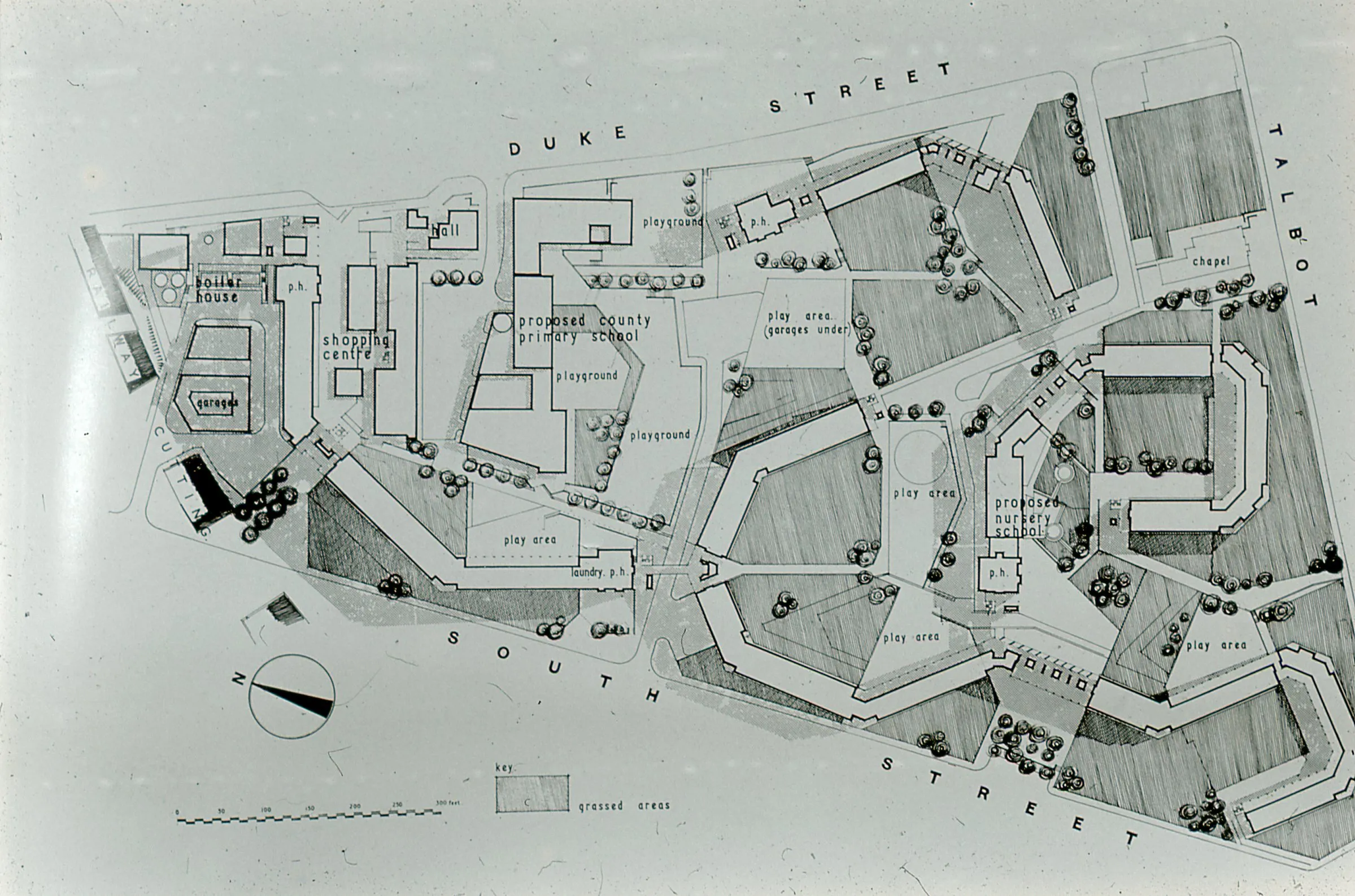
Concrete was cheap, strong and quick, which in the years after 1945 made it the natural material for the largest social promise Britain had ever made: decent housing, at scale, for people who had never had it. This is the ambition the grey photographs erase. The popular critique of this, arguably unfulfilled, ambition is usually told as though the buildings themselves broke it.
Park Hill in Sheffield, built between 1957 and 1961, ran wide access decks the full length of the structure — “streets in the sky,” broad enough for a milk float, so that a flat sixty feet up still opened onto something like a street with neighbours on it. Ernő Goldfinger’s Trellick Tower, completed in 1972, gave its tenants generous ceiling heights, cross-ventilation and long views most private flats of the period never offered. Alison and Peter Smithson’s Robin Hood Gardens, in east London, was an argument in concrete about communal life. The intention behind all of them was not utopian sentiment but a specific brief: give ordinary tenants light, air, space, and a front door onto a shared world. Hold that word — ambition — because what happened next is normally narrated as if the buildings reneged on it themselves.
What actually failed
They did not. The honest history of British brutalism is not that the architecture failed but that it was failed — administered into disrepute by decisions taken about it long after the ribbon was cut. Maintenance budgets were cut, caretakers withdrawn, lifts left broken for months; the social balance of a block altered by changes in how its flats were let. A building designed on the assumption that it would be looked after was, repeatedly, not looked after, and then blamed for the result. The concrete was convicted for the sins of its custodians.
That is the core of the case, but it only holds if it meets the real objections rather than a caricature of them, so here are the three that carry weight.
The first is that it weathers badly, and this is simply true. Bare concrete in a wet northern climate streaks and stains; water tracks down a façade and leaves the dark run-marks a camera loves. But the answer to a material that shows dirt is maintenance and detailing — a drip mould here, a considered fall there — not cladding the honesty away behind plastic panels, which is the lineage that ends at Grenfell. The tropical buildings below weather differently, and the difference is instructive.
The second is that the scale can be inhuman, and of the worst megastructures that was sometimes fairly said — decks that became blind corridors, a monotony no amount of good intention redeemed. The reply is not a flat denial. It is two buildings, in Dhaka and São Paulo, where the same material at the same scale reads as dignity and as generosity, because the brief was right.
The third is that people hated living there. Some did. But the test is what happened where maintenance and tenure held, or where a listing rescued a building from managed decline. Trellick Tower, once the tabloids’ “Tower of Terror,” was listed Grade II* in 1998 and is now among the more sought-after addresses in west London. Park Hill, listed the same year and part-rebuilt by Urban Splash into mostly private flats, went from condemned to coveted. The buildings did not change. Their custodianship did. It is not a defence of every estate ever poured, but it does underline the observation that the failures were administered, not built.
Dhaka: the concrete that carries a nation
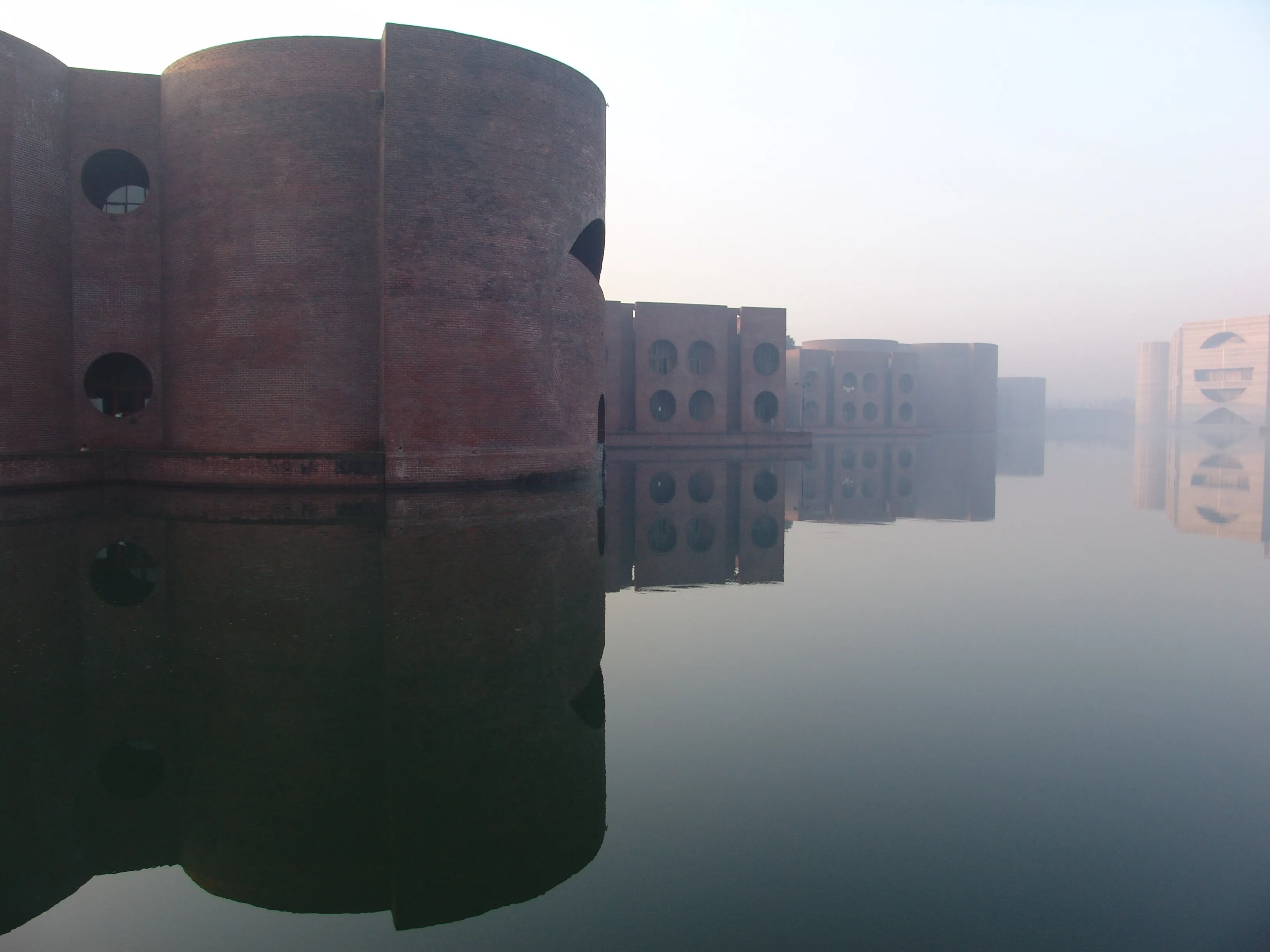
The single building that answers the charge of inhumanity most completely is not in Britain at all. It is Louis Kahn’s National Assembly of Bangladesh — Jatiya Sangsad Bhaban — in Dhaka, and its history is the argument in compressed form. It was conceived in 1959 as a second-capital assembly for the eastern wing of Pakistan; Kahn was commissioned in 1962; construction began in 1964; work halted during the 1971 war of independence; and the building was finished in 1982, eight years after Kahn died in 1974. The design that began as an outpost of one state was completed as the parliament of a new one — the same drawings, a different nation.
What Kahn built is monumental concrete inset with bands of marble, pierced by enormous circles, triangles and rectangles that are not windows in any ordinary sense but apertures cut clean through the outer layer, so that daylight enters and moves across the interior through the day like weather. There is a good monograph on Kahn for anyone who wants the plans; the point for this argument is what the building does to the word “brutalism.” Here the concrete reads as permanence and self-determination rather than austerity. It is the most complete rebuttal available to the claim that the material is anti-human, because in Dhaka the concrete carries a country’s founding, and it does not flinch under the weight.
São Paulo: the concrete that welcomes
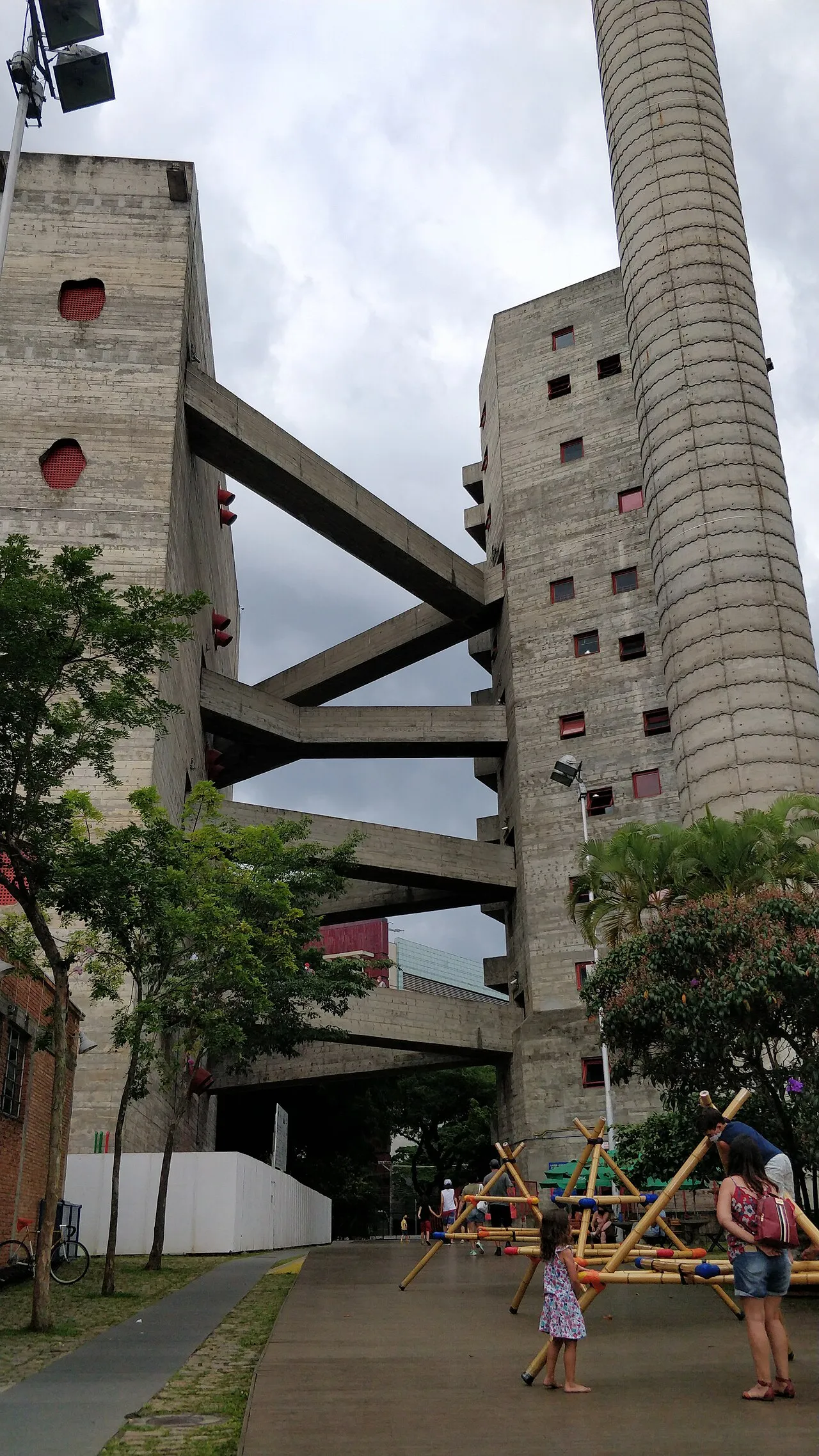
If Dhaka answers the charge of coldness with grandeur, Lina Bo Bardi answered it with warmth. Her SESC Pompéia, in São Paulo, was a disused drum factory that she converted between 1977 and 1986 into a leisure, sport and culture centre for workers — and the conversion is a manifesto. She left the concrete and brick exposed, kept the old factory sheds, and spent the budget on the public rather than the finishes: on wide communal floors, a water channel children could paddle in, irregular organic openings punched through an unclad tower of sports halls. Those openings were cut jagged and deliberately uneven, a rebuke to the smooth curtain wall — concrete made to feel worked by a person rather than poured by a machine. Craft and labour were prioritised over expensive materials as a matter of principle, not economy.
The result is a building that functions as a vast public living room, and it is the cleanest proof that the material’s coldness is a use, not a property. The same concrete that can read as a barracks can read as a welcome, and which one you get depends entirely on what the building was asked to do. Bo Bardi is a counterweight to Dhaka rather than a second monument — grandeur and generosity are the two ends of the range the material can hold.
The sun, and the honesty
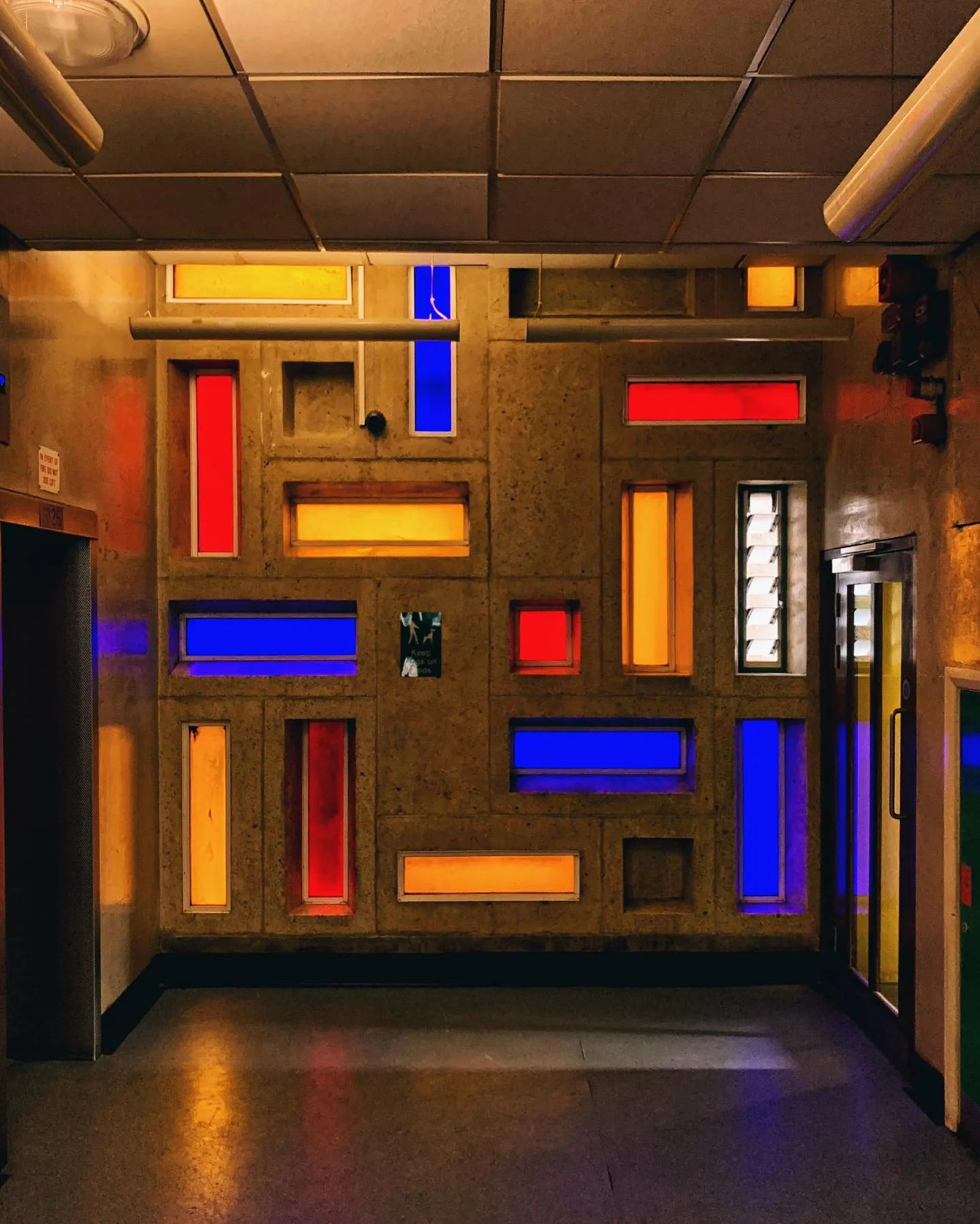
Which returns us, by way of the sun, to the point about honesty. In the tropics at the moment of independence — Ghana, India, Nigeria — a generation of architects reached for concrete not for its cheapness but for its shade. The brise-soleil, the deep concrete louvre that shields a window from direct sun, is not decoration bolted onto a façade; it is structure doing the work of a climate. The V&A’s 2024 exhibition Tropical Modernism: Architecture and Independence set out the politics behind that shade — the British architects Maxwell Fry and Jane Drew building in West Africa and India, and the newly independent nations who took the idiom and made it their own. The term matters, and the show was careful with it: much of what gets loosely called “tropical brutalism” is more precisely tropical modernism. This is the same postcolonial thread followed in the piece on modern design’s debt to Africa — concrete as a material of independence and climate, not only of the British welfare state.
The brise-soleil is the argument in a single element. It looks the way it looks because of what it does; nothing is applied and nothing is pretending, so the shade is the ornament and the ornament is structural. That is what brutalism’s beauty finally comes down to — not prettiness, which it mostly forgoes, but the harder beauty of a thing that keeps no secrets: a building that shows you what it is made of, how it stands, and, where the brief was honest, who it was built for. The concrete told the truth. It is long past time we stopped blaming it for the lies that were told about it.