Understand
Wabi-sabi was never a look
In the 1580s, the most powerful man in Japan got down on his hands and knees to enter a hut.
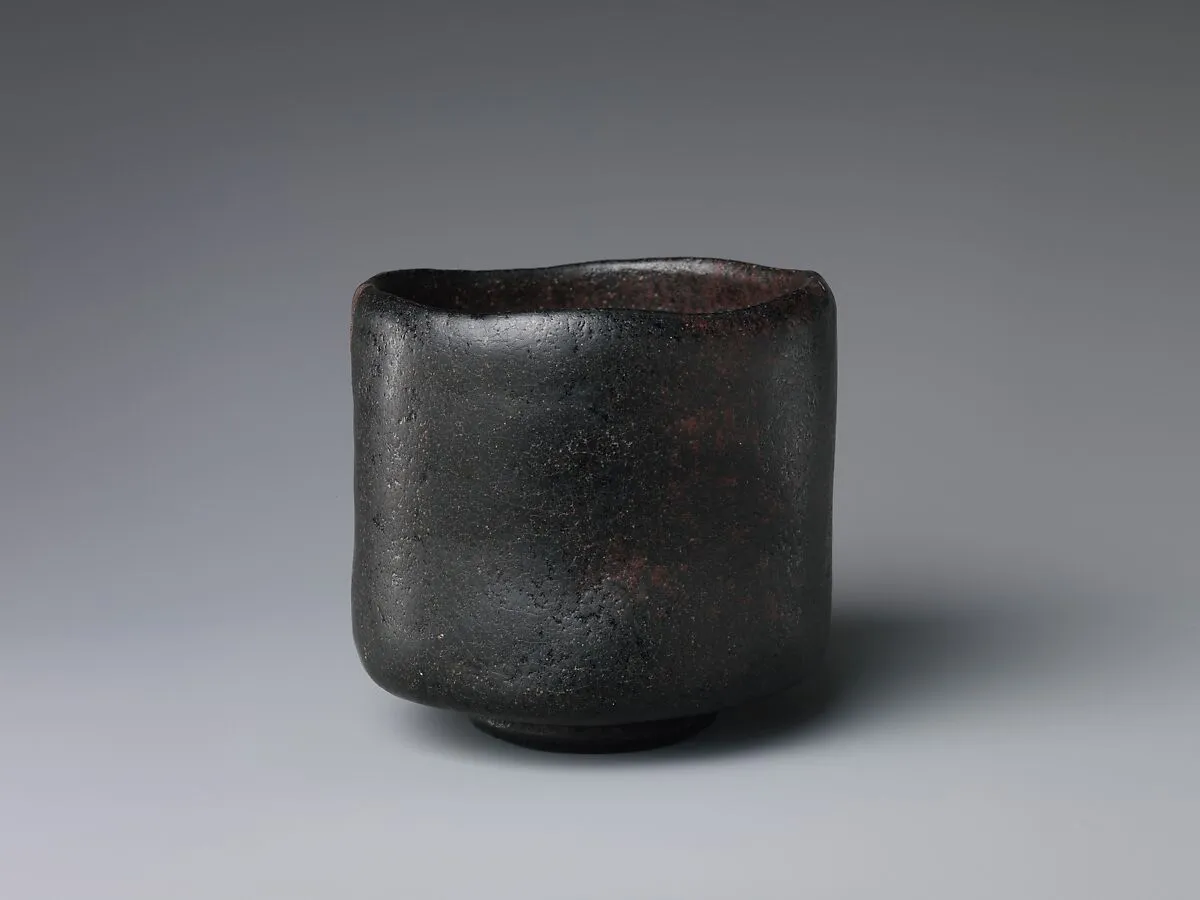
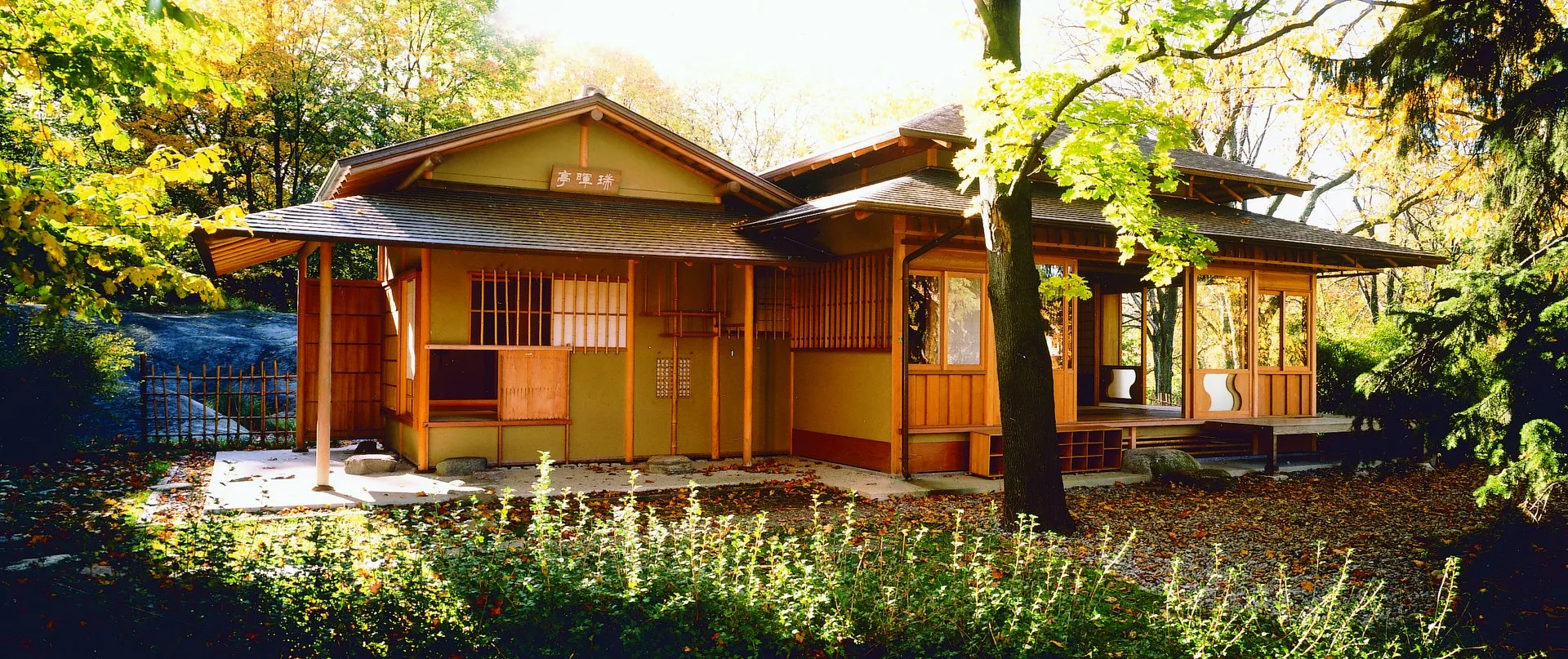
Toyotomi Hideyoshi had all but unified the country by force, and he was visiting the tea master Sen no Rikyū. The doorway he had to use, the nijiriguchi, was barely two feet square. It was built that way on purpose. Anyone entering had to crouch and bow their head; a samurai had to leave his sword on the rack outside, because it would not fit through the opening with him. Inside were two tatami mats, earthen walls, and almost nothing else — a single hanging scroll, perhaps one flower, a rough bowl with no decoration on it at all.
None of this was poverty. It was the performance of poverty, staged by a man who was among the richest in the country, for a man who could buy anything that existed. The bareness was an instrument, and a sharp one: it stripped rank at the door and made the warlord kneel. Within a few years the relationship would curdle, and in 1591 Hideyoshi ordered Rikyū to cut open his own stomach. Taste and power were never separable in that room.
It is the right place to start, because almost everything now sold under the name wabi-sabi has forgotten what that room was for.
Two words, not one
Wabi and sabi are two words, and for most of their history they were not even spoken together.
Wabi (侘) began as a word for wretchedness — the chill and isolation of living poor and alone, away from the comforts of company. Across the fifteenth and sixteenth centuries, in the hands of the tea men, it was turned inside out. The want became the point. The austerity became a kind of wealth. Murata Jukō (1423–1502), the merchant’s son from Nara usually named as the first of the wabi tea masters, is supposed to have left his pupils a line that captures the inversion exactly: he preferred the moon seen through drifting cloud to the full moon in a clear sky. Lack was the more interesting condition. He is also remembered for a pointed instruction to his pupils — to stop drawing a hard line between Japanese and Chinese wares — aimed at a tea culture that, in his day, measured a host by how many Chinese treasures he could set out on display. The turn toward the plain and the local was there from the very start, and it had an edge to it.
Sabi (寂) came from poetry, not tea. It names what time does to things — the rust, the fading, the quiet of the worn and the old — and it carries, in its sound, the verb for withering. It belongs to the world of linked verse and, later, the haikai of Bashō’s circle: the beauty of the impermanent, caught on its way out.
The compound we now treat as a single ancient philosophy — wabi-sabi, the embrace of imperfection — is largely a modern convenience. The two ideas have different parents, one in the teahouse and one in the poem. One is spatial and social, the other is temporal and elegiac. The smooth fusion that reaches a Western reader as seamless, ancient wisdom was mostly assembled much later, and partly somewhere else entirely.
The men who built the cult of the humble were not humble
Rikyū was born in 1522 in Sakai, the merchant port, into a family of warehouse traders and fish dealers. The great tea masters were the financiers of the richest commercial city in Japan, and their austerity was a connoisseur’s austerity — expensive, exacting, and entirely deliberate.
The most famous story told about Rikyū makes the point, though it is worth saying plainly that it is a parable rather than a documented fact; these tales circulate in tea circles the way certain stories circulate in religious ones. Hearing that Rikyū’s garden of morning glories was extraordinary, Hideyoshi invited himself to see it. Rikyū had every bloom in the garden cut down before the warlord arrived, and set, in the alcove of the tea room, a single flower. It is told as a lesson in restraint. It is also a display of control so total that it destroys a garden to stage one stem. Restraint, performed at that pitch, is not the opposite of power. It is a form of it.
The performance could be scaled up, too. In 1587 Hideyoshi staged an enormous public tea gathering at Kitano, in Kyoto, open to anyone who turned up with a kettle and a mat; close to a thousand people are said to have come. The plain style that began as a retreat from display had become, in his hands, a piece of mass political theatre — the ruler as the nation’s tea host. Humility, conducted on that scale, is just another way of being seen.
Nothing shows the distance between an object and the meaning poured into it better than the most revered tea bowl in Japan. The Kizaemon Ido is a Korean rice bowl. An unknown potter threw it in an ordinary kiln in the south of the Korean peninsula in the sixteenth century — one of thousands, made for poor people to eat from, the kind of thing meant to be used hard and thrown away. Japanese tea men prized exactly these koraimono, Korean wares, for their plainness, setting them against the celadon and the dark glazes of the karamono, the prized Chinese things. The wabi sensibility was, from the start, a turn away from imported luxury and toward the cheap and the local.
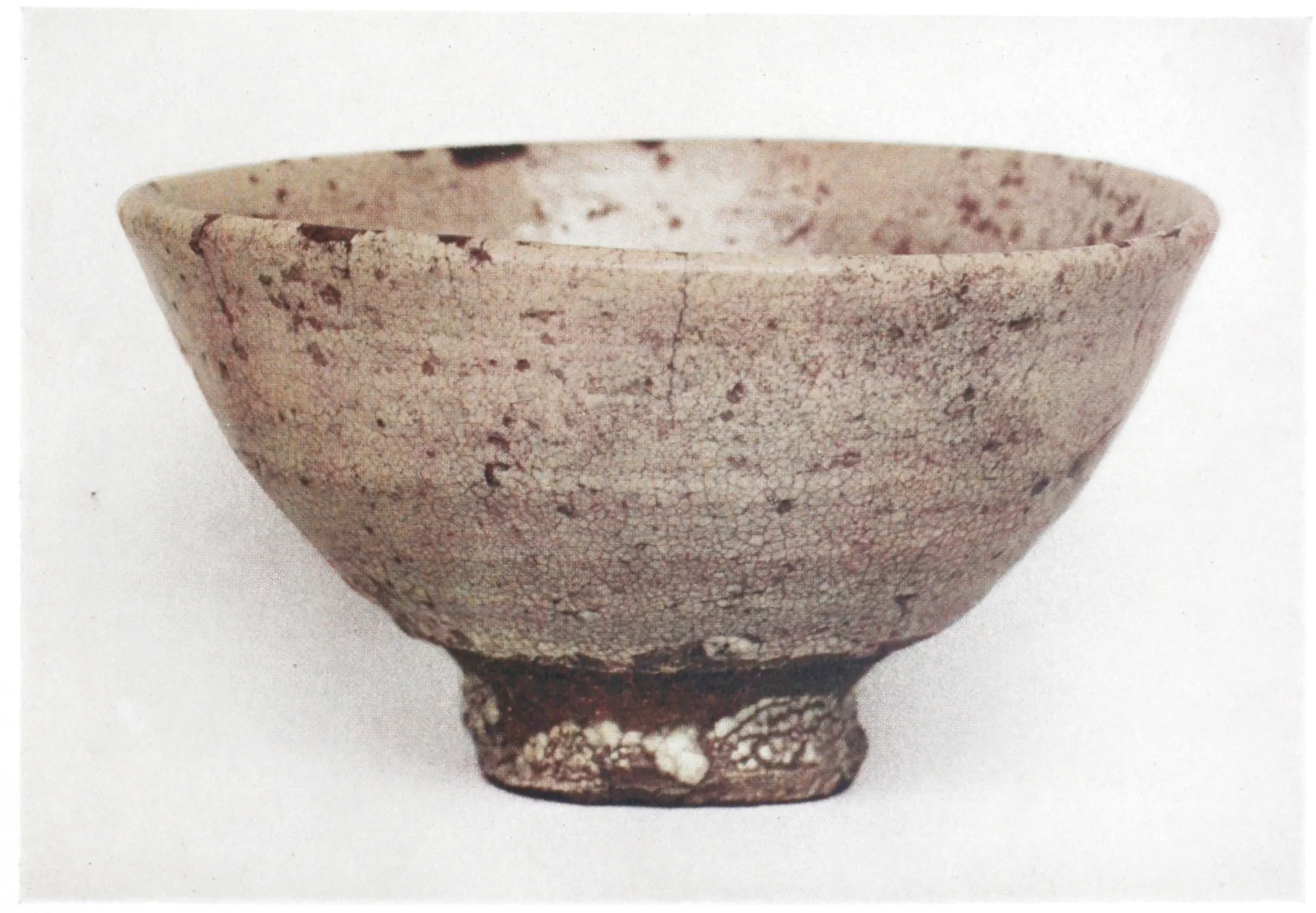
The bowl passed through wealthy hands — one eighteenth-century lord paid a small fortune for it, despite a persistent rumour that it cursed its owners with boils — and ended up at a subtemple of Daitoku-ji in Kyoto. In 1951 the Japanese state named it a National Treasure. Today it lives at that temple wrapped in silk inside a nest of five boxes, shown to almost no one. When Yanagi Sōetsu, who founded Japan’s folk-craft (mingei) movement, was finally allowed to see this supreme object, what he recorded was surprise at how ordinary it was: a plain bowl, no ornament, no calculation, the commonest possible crockery. His account, carried into English by the potter Bernard Leach in The Unknown Craftsman, did as much as any single book to give the West its picture of Japanese beauty.
The reverence is not wrong. But the meaning was supplied by the beholder. The potter had no idea he was making a masterpiece.
The version that reached the West
The wabi-sabi that travelled arrived with a particular spin, and it is worth knowing who put it there.
D.T. Suzuki, more than anyone, sold Zen to twentieth-century Western readers — and he sold it as a single wordless experience that was the hidden ground of all Japanese culture, from swordsmanship to flower arranging to tea. The historian of religion Robert Sharf has argued that this picture owes less to medieval Zen than to the cultural politics of modern Japan: that in the Meiji era and after, Japanese thinkers reframed Zen as the spiritual essence of the nation — evidence that Japan possessed an intuition of unity and nature that the analytical, materialist West had lost — and exported the idea to audiences flattered to receive it. It is a contested reading, and Suzuki has his defenders. But it is a useful corrective. The “Zen” in which wabi-sabi now sits so comfortably was, in part, a modern product built for foreign consumption. Suzuki liked to draw the contrast in tidy columns — the Western mind analytical and dividing, the Eastern mind synthetic and whole — a picture flattering to readers on both sides of the line.
Two books did much of the rest. Junichirō Tanizaki’s essay In Praise of Shadows (1933) — really a lament for the soft dimness of traditional Japanese rooms against the glare of electric light — gets folded into the subject wherever it comes up, though it never uses the term the way we now do. And in 1994 the American designer Leonard Koren published a slim, well-made book, Wabi-Sabi: for Artists, Designers, Poets & Philosophers, which fixed the concept for the design world more firmly than any other single text. A great deal of what a reader today takes to be ancient Japanese wisdom about imperfection traces not to Rikyū’s room but to Koren’s pages.
From there the concept hardened into a category. By the 2000s and 2010s, wabi-sabi had a shelf in the wellness aisle and a recurring spread in the interiors magazines: a way to sell calm to people who suspected they owned too much and moved too fast. The less a buyer needed to know about Rikyū or Jukō, the more freely it travelled.
Chinoiserie, Japonisme, and the long habit
Europe had been dreaming about the East for centuries before it had a use for the word wabi.
In the seventeenth and eighteenth centuries the dream took the form of chinoiserie — the craze for an invented China of pagodas, blue-and-white porcelain and lacquer, much of it produced in workshops in France and England by people who had never been within several thousand miles of the place. The European imitation of Asian lacquerwork was called, with magnificent indifference to geography, japanning. China, Japan and “the Indies” blurred into a single decorative elsewhere. The point of chinoiserie was never accuracy; it was appetite. It handed Europe a portable, purchasable East.
The nineteenth century brought it into focus. After 1853, when American warships forced Japan to open its ports, Japanese prints and objects flooded into Europe, and Japonisme — a genuine engagement with the flatness, cropping and asymmetry of the woodblock print — reshaped Whistler, the Impressionists and Art Nouveau. It belongs to the same family as the formal debts Western design would later owe elsewhere: a borrowing from a culture half-understood.
What all of it shares, and what the critic Edward Said named in 1978, is a turn of mind: the East imagined as the West’s opposite and its remedy — settled where the West is restless, spiritual where the West is acquisitive, whole where the West feels divided. Wabi-sabi, as it is now sold, is the late and comfortable form of that habit. It offers the East as a course of treatment for consumer anxiety: buy the rough bowl, slow down, want less.
The complication — and it is the genuinely interesting part — is that the traffic ran both ways. The idea of an untranslatable, uniquely Japanese sensibility was not simply pressed onto Japan from outside. Japan helped build it and helped sell it. The postwar literature of nihonjinron, the “theories of Japaneseness,” made both a national identity and an export commodity out of exactly this mystique. In the wabi-sabi case, orientalism is partly self-orientalism. The result is an odd hall of mirrors: the West buys an antidote to its own appetites, and Japan sells the cure as a product. Each side gets the exchange it came for.
The circle closes
Which brings the story back to Rikyū’s hut.
Wabi started as a move away from imported status — away from the costly Chinese karamono and toward the plain, the local, the cheap Korean bowl. Four hundred years later it has become, in London and New York and across a great many Japandi mood boards, an imported status object in its own right: a look you can buy, a palette of oatmeal and clay and undyed linen, a more expensive way to own fewer and rougher things. The diluted version usually trades under wabi-sabi now, which keeps the colours and the texture and quietly drops everything underneath them. The gold-seamed kintsugi mug, its crack picked out and sold at a premium, is the neat emblem of the whole process — a philosophy of repair turned into a manufacturing finish. Much of what we consider wabi-sabi keeps the oatmeal palette and the matte ceramic and files off the sixteenth-century argument, which was the only part that ever asked anything of you.
What is actually worth keeping
None of which means the idea is empty.
There is something real in wabi-sabi worth holding onto, and it is not a shopping list. It is an argument, and a demanding one, against the new and the flawless. It says that an object earns its place by being used; that age is not damage; that the marks a thing takes on from being lived with are the best thing about it, not the worst. It is, taken to its conclusion, a quiet case against shopping at all — an awkward foundation on which to build a homewares trend. Followed honestly, that points almost exactly away from the market now trading in its name. It does not ask you to buy a distressed bowl, or to replace what you own with rougher and dearer versions of the same. It asks you to keep the bowl you already have, and to look at it properly.
Rikyū’s room was never a look. It was an argument about how to live with things. That is still the part worth crawling through the small door for.