Understand
What modernism took from Africa, and what Africa did with modernism: the long history behind 'Afrohemian'
In December 2025, Pinterest published its forecast for the year ahead and handed one of the season’s interiors trends a name that had not existed a few seasons before: Afrohemian. The numbers under it were real. Searches for “afrobohemian home decor” had climbed 220 per cent year on year; “adire fabric,” the indigo-dyed Yoruba cloth, by 130; “motif berbère,” the geometric Berber rug pattern, by 210. The platform’s own copy was cheerful about where all this was going. Decor, it promised, was “going to Dakar and beyond.”
It is a likeable trend, as these things go. The brief is warmth over minimalism, handwork over the algorithmically smooth, a room with a story in it rather than a showroom’s worth of beige. The recommended ingredients — mudcloth, Tonga baskets, Ethiopian icons, ochre and clay and indigo — are mostly real objects made by real people. There are worse instincts than wanting to live among things that a hand has touched.
But read the trend copy again and notice what is missing from it. It names textiles, colours, a continent and a city. It does not name a single person. Not a weaver, not a designer, not a town, not a tradition older than the search term. The look has been lifted clean off its makers. And that particular subtraction — African form arriving in a Western interior with the names filed off — is not a 2026 invention. It is almost exactly a hundred and twenty years old.

The first crossing
In the late spring of 1907, Pablo Picasso walked into the Musée d’Ethnographie du Trocadéro in Paris and had an experience he spent the rest of his life half-denying. The museum was a dim, neglected place that displayed its African and Oceanic objects not as art but as evidence — material that had reached France through the supply lines of empire, sorted by region and ritual function, the makers unrecorded. Picasso found it repellent and could not make himself leave. The masks, he told André Malraux many years later, were not sculpture at all. They were “magic things.”
He was twenty-five and halfway through a large, difficult canvas. X-rays of Les Demoiselles d’Avignon show that all five women began with the same almond-eyed faces; sometime after the Trocadéro visit Picasso painted over the two on the right and gave them the scored, angular features that most scholars read as African masks. The painting he finished that July is routinely described as the hinge on which modern art turns — the moment European painting abandoned the single fixed viewpoint it had held since the Renaissance. The hinge was greased by objects whose makers nobody had thought worth naming.
He did not even discover them first. By 1907 the painters around him had been collecting African carvings for several years: Maurice de Vlaminck and André Derain were already buying, and in 1906 Henri Matisse had shown Picasso a small Congolese figure from his own collection. What Europe called its “discovery” of African art was a discovery only for Europe. The work was centuries old and perfectly well known to the people who made it — Fang, Kota, Senufo, Bambara, each with its own forms and purposes, all of it flattened by the Paris dealers into a single marketable category, art nègre. The objects arrived on the same boats and through the same conquests that produced lurid newspaper stories about Dahomey and, a few years earlier, Joseph Conrad’s account of the Congo. The aesthetic revolution and the atrocity travelled the same routes.
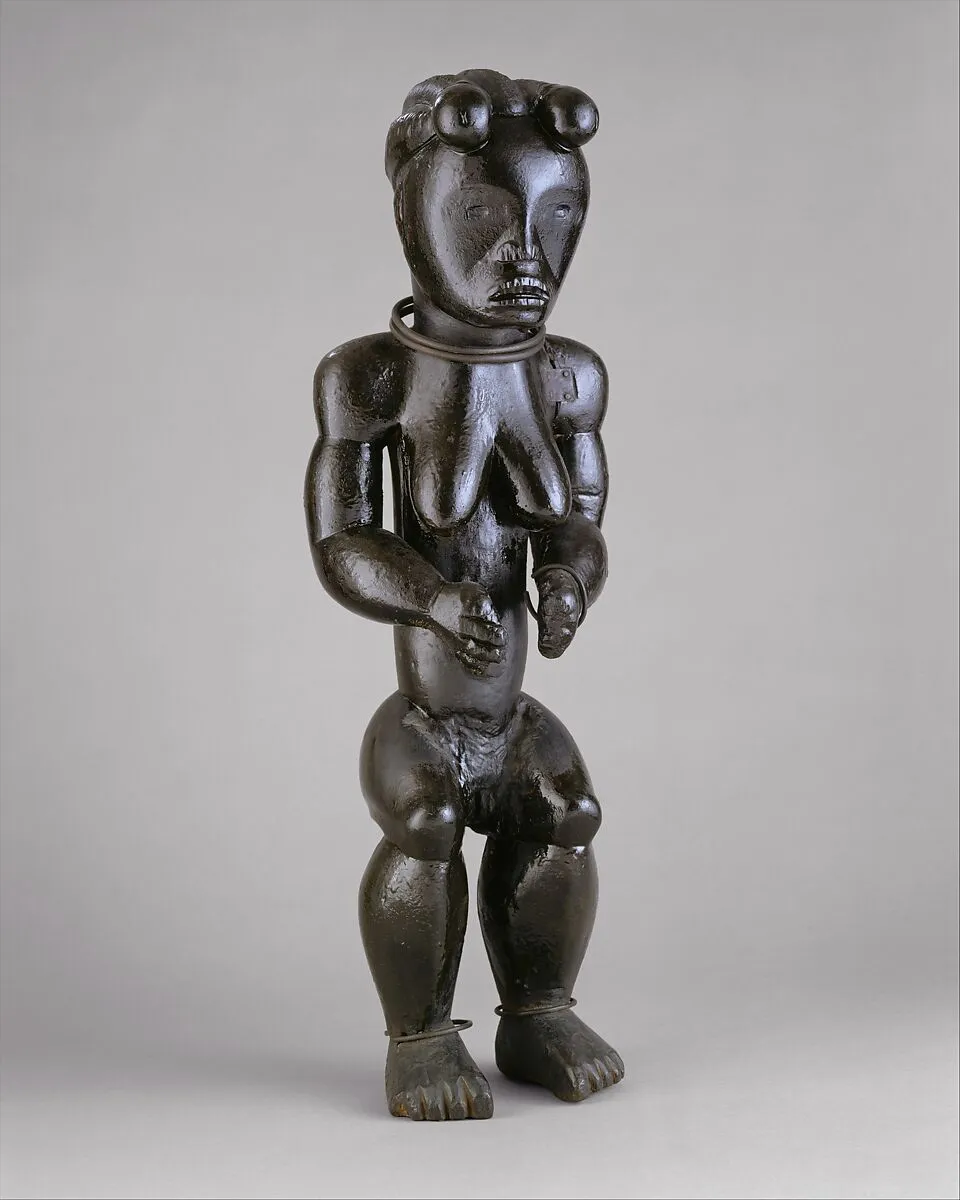
What the modernists took was not a motif but a permission. African sculpture treated the human head as a sign rather than a likeness — a thing built from planes and volumes according to its own internal logic, not measured against a mirror. A nose could be a ridge, an eye a hollowed socket, a face a piece of geometry. For a European tradition that had spent four centuries chasing ever more convincing illusion, this was not a new decoration to apply but a door out of the room. That is the real debt, and it is precisely why it matters who gets named: the thing borrowed was not a pattern but an idea about what art is for.
What is genuinely striking is how hard Picasso worked to deny the debt. For years he credited Iberian sculpture, Cézanne, anyone but the masks. The argument has never fully closed. in 2025 a French collector reignited it by claiming the true source was medieval Catalan frescoes, and was met by art historians, Suzanne Blier among them, holding that the African influence is foundational and not seriously in question. That a quarrel this old is still being fought is itself the point. The credit was contested from the very beginning, and the contest was always about whether African art counted as art at all.
From painting, the vocabulary passed into sculpture — and here it ran through named European men who were themselves borrowing. Constantin Brâncuși, often called the father of modern sculpture, built his radical simplifications out of two sources at once: the folk carving of his native Romania and the African work he saw in Paris galleries and in his New York dealers’ collections. His signature method, direct carving — cutting straight into wood or stone with no clay model, letting the material keep its own logic — was the technique African carvers had always used and the European academies had abandoned. Through Brâncuși it spread to a whole British generation: Henry Moore, Barbara Hepworth, Jacob Epstein.
In 1927 a young Japanese-American sculptor named Isamu Noguchi arrived in Paris and spent several months as Brâncuși’s assistant. The two men barely shared a language and worked largely through gesture and the handling of tools. Noguchi went in a figurative realist and came out something else entirely: his work turned abstract, biomorphic, pared back to essential form. The lesson he took from Brâncuși was, in part, the lesson Brâncuși had taken from Africa. (Hayden Herrera’s biography traces the shift in detail.)
Noguchi was not a bystander to the modern interior. He was inside it. When the Museum of Modern Art ran its 1940 competition for Organic Design in Home Furnishings — the contest won by Charles Eames and Eero Saarinen, the one that produced the single moulded shell and launched the Eames office — Noguchi belonged to the same small design world the prize crowned. The curved, organic, weight-bearing forms that still define mid-century furniture did not descend in a tidy straight line from a Fang mask, and it would be glib to claim they did. But they sit at the end of a chain — mask to Brâncuși to Noguchi to the milieu that produced the Eames shell — along which African form travelled freely and African names did not. You can buy the chair this afternoon, on almost any high street. You will not find, anywhere on the tag, the word that set it moving.
The answer from a few streets away
It would be easy to stop there, with Africa as the quarry and the West as the quarryman. But the fuller story was already taking shape a short walk from the Trocadéro, at almost the same moment.
In the Paris of the 1930s, three students from the French colonies — Aimé Césaire from Martinique, Léon-Gontran Damas from French Guiana, and Léopold Sédar Senghor from Senegal — began meeting to talk about the thing a French colonial education had trained them to be ashamed of. Out of those conversations came Négritude. It was Césaire who coined the word, taking the slur nègre and turning it into a flag. They drew on the Harlem Renaissance and on surrealism, held salons that pulled in Black writers and artists from across the diaspora, and later gathered around the journal Présence Africaine. The movement is usually shelved under poetry and politics. It was also, and crucially, a theory of art.
Senghor — who would become Senegal’s first president in 1960 — argued that African art had never been trying to do what European art did. Its purpose was not to copy the surface of the world or to flatter it but to reach what he called the sub-reality: the field of vital forces beneath appearances. Rhythm, for Senghor, was “the architecture of being.” Set his account of African sculpture beside what the modernists believed they had stumbled on at the Trocadéro — that art might stop reproducing surfaces and start handling the forces underneath them — and you find them describing the same discovery. The difference is that Senghor was describing it from the inside, as an inheritance, while Picasso met it as a shock from outside. The philosopher Souleymane Bachir Diagne has since made the case at book length that this was not a mood but a metaphysics — African art as a way of thinking, not merely a way of decorating.
Then Senghor did something that closes the loop with almost rude precision. In 1972, a sitting head of state, he organised an exhibition of Picasso and wrote a text to go with it — Picasso en Nigritie, Picasso in the land of Blackness. The essay reread Western primitivism through the lens of Négritude and quietly turned the usual question of influence on its head. The man whose tradition had been mined anonymously in 1907 now had a successor curating the miner, and reframing the theft as a conversation. Six years earlier he had staged the first World Festival of Negro Arts in Dakar, putting Black artists from across the world on a single stage. Africa, by then, was very obviously not waiting to be discovered.
None of which should be polished into a fable, and Senghor’s own continent refused to let it become one. The Nigerian playwright Wole Soyinka punctured the whole project with the gibe that a tiger does not proclaim its “tigritude” — it simply pounces. The charge was that Senghor’s insistence on an essential African sensibility, all rhythm and intuition and feeling, risked taking the colonial stereotype and merely flipping its sign from minus to plus. The state-sponsored Négritude aesthetic of the École de Dakar, which grew out of his presidency, has been criticised — fairly — as a style handed down from above. Négritude was an answer to erasure, not a settled truth. But it was an answer, made by named people, and it is the reason Africa is never only the object in this story.
The second crossing
The next time modern design crossed between Europe and Africa, it went the other way — and it did not arrive as a gift.
In the 1940s, on the Gold Coast that would become Ghana, two British architects named Maxwell Fry and Jane Drew worked out how to build modernist buildings in the tropics. The enemies were heat and humidity; the answer - Tropical Modernism - was concrete shaded behind brise-soleil screens, lifted on stilts, slotted and perforated so that air moved through it. You can see the logic at its cleanest in the deep concrete grille they built for the University of Ibadan library, or in the schools they raised across the region. It was elegant, and it was not charity. The buildings were paid for from the Colonial Office’s postwar development fund, and their job was to manufacture a more comfortable administrator and a more productive colonial subject — to make late empire pleasant enough to soften the rising demand to be rid of it. Fry and Drew codified the method in a 1956 textbook and taught it to a generation of European architects through the Department of Tropical Architecture they founded at London’s Architectural Association in 1954.
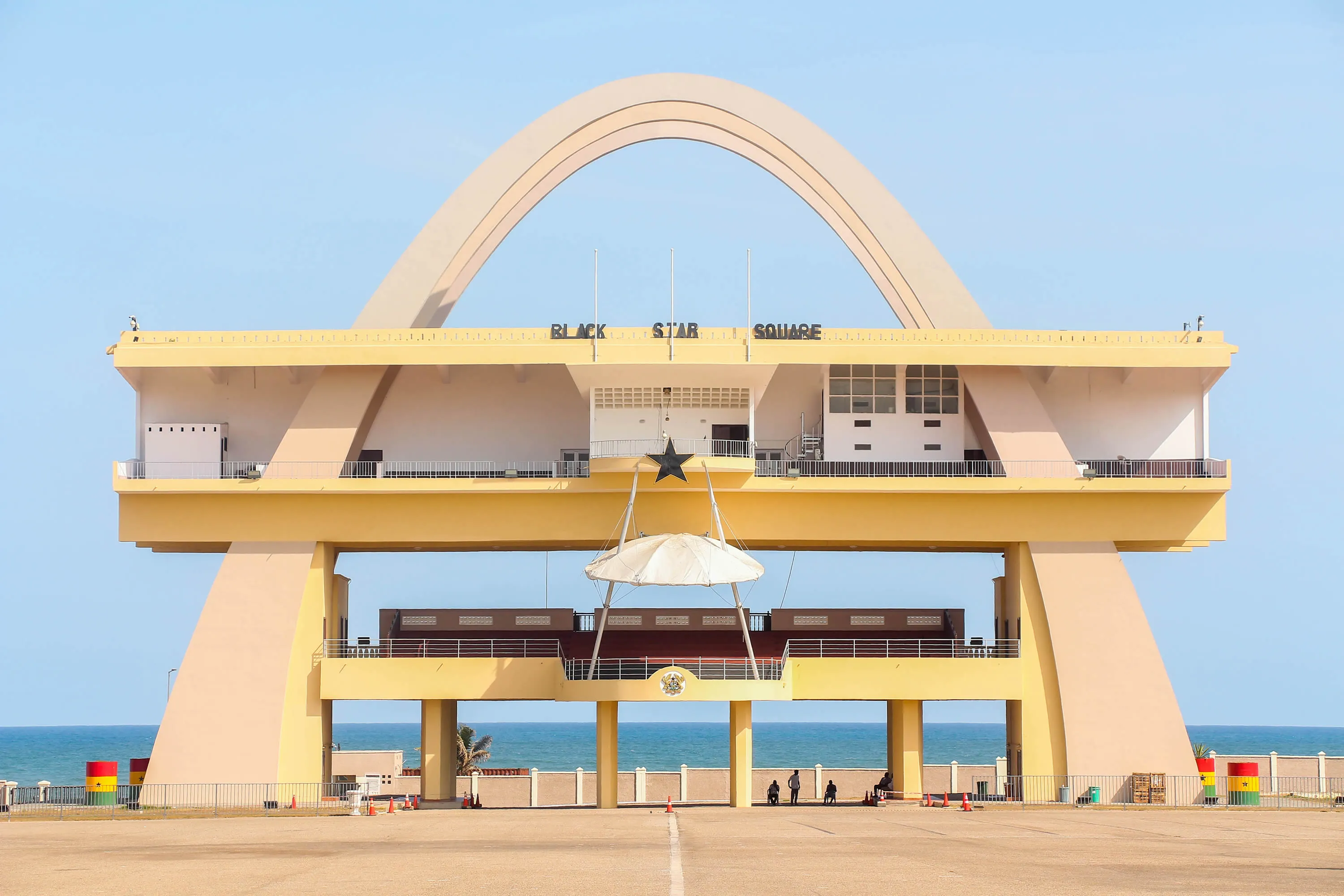
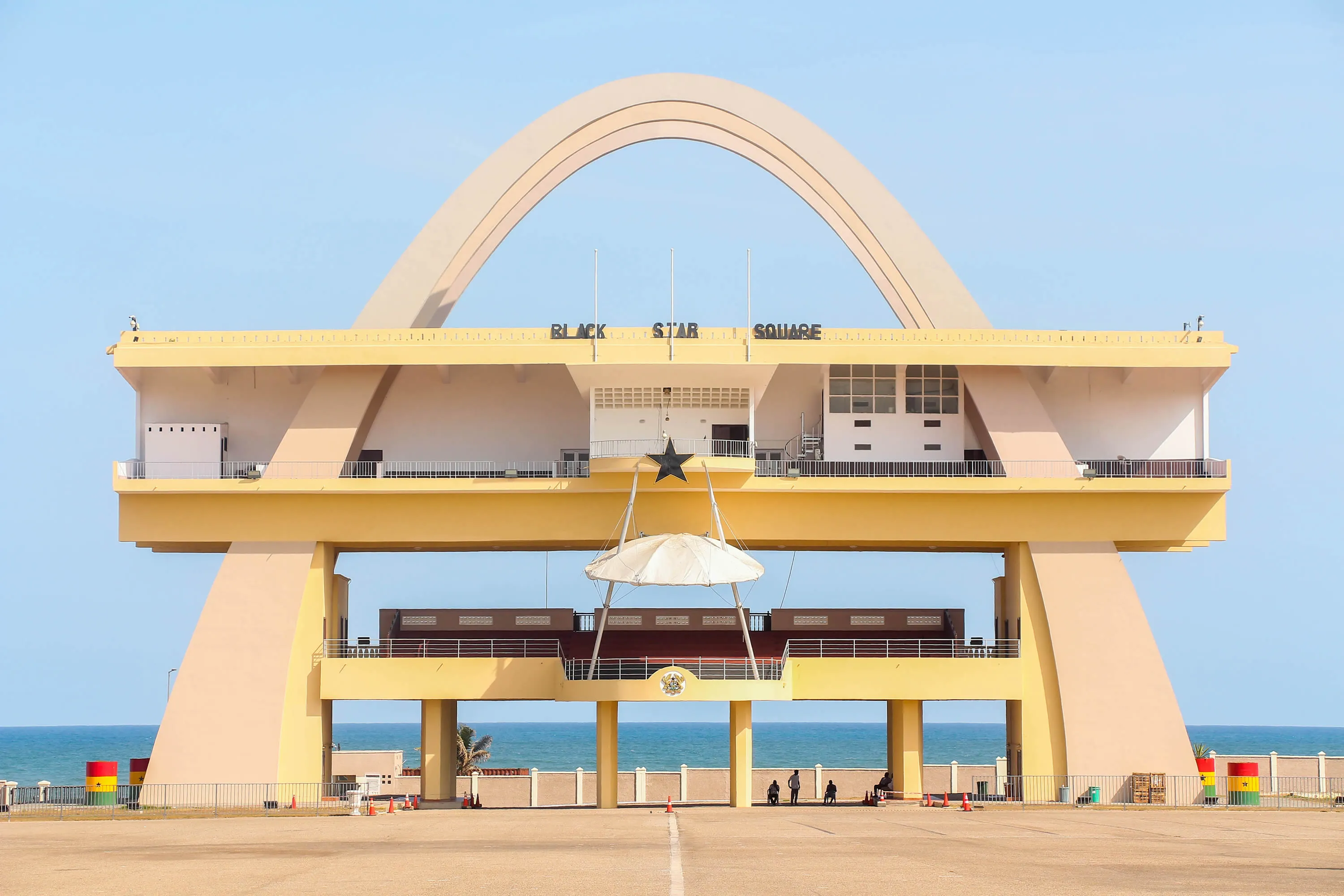
And then the demand to be rid of empire won. The seeds had been sown partly in England — at the 1945 Pan-African Congress in Manchester, where a young Kwame Nkrumah was among the organisers. Ghana took its independence in 1957, and Nkrumah, its first prime minister, did something unexpected with the colonisers’ architecture. He kept it, and changed what it meant. The clean concrete lines that had been an instrument of control became, almost overnight, the visual language of a free and modern Africa. He commissioned Black Star Square in Accra as a parade ground for the new nation. He brought the architect Victor Adegbite back from the United States to lead state design. Most consequentially, he founded a school of architecture at what became Kwame Nkrumah University of Science and Technology in Kumasi, so that the next generation of Ghanaian architects could train at home rather than in London.
The point of that school was authorship. Its first African head of department, John Owusu-Addo, had trained in Britain and come home to build and to teach; his Unity Hall at the university stacks student rooms into ventilated nine-storey blocks that handle the climate with no colonial administrator anywhere in the brief. Where the first crossing had stripped African makers of their names, this one made African names the entire point. The buildings were signed, deliberately and publicly. That insistence was not ornament; it was the argument. A nation proving it could author its own modernity had to be seen to author it — in full, with credits attached.
And ordinary Ghanaians inhabited it. One image that survives from the period shows a shop assistant called Sick Hagemeyer posing, in 1971, as a seventies icon in front of the modernist headquarters of a trading company in Accra — not a dignitary, not an architect, a young woman treating the new architecture as the natural backdrop to a modern life. That is what reclamation looks like from the ground: not a manifesto, a photograph.
The contradictions were there too, and they are part of the honesty of it. When Nkrumah’s government built a great round pavilion for a trade fair, its aluminium roof — shaped to echo the baobab and the chief’s umbrella, two West African symbols of authority — was shipped in from Britain. And Nkrumah himself was overthrown in a 1966 coup, before that pavilion even opened to the public. Cheap air-conditioning eventually made the careful passive cooling redundant, and many of the finest Tropical Modernist buildings now stand decaying or demolished. There is an irony there worth sitting with: structures designed to cool themselves without electricity, abandoned the moment electricity made cooling cheap, now read less like period pieces than like prophecy. In a warming world their logic — shade, cross-draught, thermal mass — is being studied all over again. And the names survived. A recent V&A exhibition — and its catalogue — put them back at the centre of the history where they belong. Owusu-Addo, in his nineties, lived to sit for the interviews.
What the pinboard keeps and what it drops
So there are two crossings, running in opposite directions, with the same question threaded through both. In the first, African form enters Western design and the makers’ names fall away — the masks at the Trocadéro, the technique behind the chair, all of it absorbed and uncredited. In the second, a Western style enters Africa and is deliberately re-signed, claimed by named architects as proof that they could build their own future. The West took the form and kept the names off it. Africa took the style and put the names back on. A subtraction one way; an insistence the other.
Which brings us back to the pinboard. It would be cheap to write Afrohemian off as a shallow trend, and it would also be false. The impulse underneath it — to live in rooms that are rooted in something, that carry a story rather than a stock code — is a good impulse, and the objects it gathers are often the real thing, made by people who deserve the sale. The trend is not the problem. The only problem is what the pinboard leaves on the cutting-room floor.
Because the language it borrows from is older and far richer than a search term can hold. It has Senghor’s sub-reality in it, and Owusu-Addo’s ventilated concrete, and a hundred-year argument about who is allowed to be named as the author of a form. “Dakar and beyond” is not a mood. Dakar is a real city with a real aesthetic philosophy that a real president spent his life building — and the trend kept the textiles and quietly dropped the man. This is the same move The Grain keeps finding in design: an authentic idea sold back to you as a look, with the thinking left out to keep the styling clean.
You can decorate without knowing any of this, and most people will. But once you do know it — once you can see the names the look spent a century mislaying — the basket on the shelf stops being a vibe and becomes the visible edge of something richer. That is the better reason to want it. Not because it photographs well. Because it has people in it.