Understand
What mid-century modernism was actually for
The movement set out to democratise design — to use industrial mass production to put genuinely considered objects into the hands of anyone who wanted them. It only partially succeeded. That partial failure is, in the end, the most instructive thing about it.
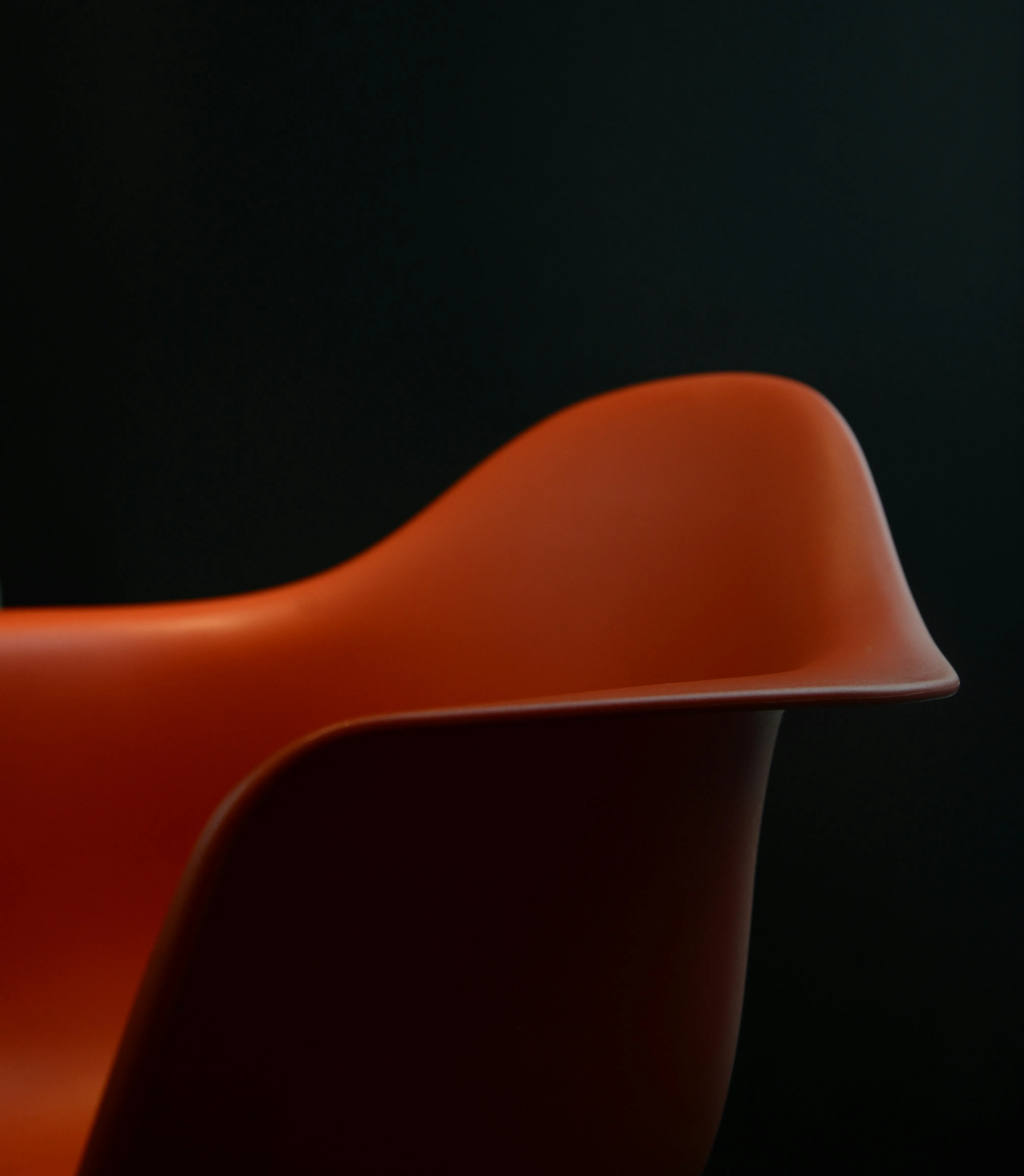
In 1950, Charles and Ray Eames sold a fibreglass shell chair through Herman Miller for $19.95, roughly £170 in today’s money. It was a deliberate act of policy. The chair had been designed to be cheap. The fibreglass body, moulded in a single piece, was borrowed directly from wartime aircraft manufacturing. The wire base required no skilled joinery. The whole object could be produced at scale, priced within reach of a young schoolteacher or a factory-floor supervisor, and it would not look like a compromise. It would look like a choice.
That specific ambition — to make the industrial process a vehicle for beauty rather than a constraint on it — is what mid-century modernism was actually for. Not the warm walnut veneer on the sideboard. Not the tapered leg. Not, emphatically, the association with a certain American television programme about advertising executives. The aesthetic is a residue. The argument behind it is more interesting.
The argument that arrived before the furniture
Mid-century modernism did not invent the idea that design should be available to ordinary people. That argument had been running since the 1880s, when William Morris — textile designer, poet, committed socialist — began insisting that the mass production of industrialisation had produced an age of ugliness, and that beauty was not a luxury to be parcelled out to those who could afford handmade objects but a human necessity. Morris’s answer, the Arts and Crafts movement, was deeply contradictory: his handmade wallpapers and fabrics were, by necessity, expensive. But the philosophical case he made — that utility and beauty are not opposable categories, that a well-made spoon or a well-built chair is a form of social justice — lodged itself in design thinking and did not leave.
Gustav Stickley, working in upstate New York from the 1890s, translated Morris’s socialism into American oak furniture: plain, structural, honest about its joinery. Frank Lloyd Wright, who absorbed both traditions, extended the argument into architecture, proposing that a properly designed house was not a status symbol but an environment that shaped its inhabitants for the better. These were, in retrospect, rehearsals.

The Bauhaus school, founded in Weimar in 1919 by Walter Gropius, made the industrial question unavoidable. If the machine was here — and it was — the question was not whether to use it but how. Gropius’s answer was that the machine should be understood as a new kind of craft tool, and that designers trained to think about mass production could make objects that were simultaneously functional, beautiful, and within reach of a wage. The Bauhaus ran for fourteen years before the Nazis closed it in 1933. Its faculty scattered — to Chicago, to London, to Tel Aviv — and what might have remained a specifically German argument became the operating system of twentieth-century design thinking.
The Bauhaus ran for fourteen years before the Nazis closed it in 1933. Its faculty scattered to Chicago, London, Tel Aviv. What might have remained a specifically German argument became the operating system of twentieth-century design thinking.
What two world wars actually changed
The conditions that produced mid-century modernism as a mass-cultural phenomenon were political and economic before they were aesthetic. The First World War had killed roughly seventeen million people and destroyed whatever remained of the nineteenth century’s confidence in inherited hierarchies. The Second killed somewhere between seventy and eighty-five million and, in its aftermath, produced a set of social settlements — the British welfare state in 1945, the Marshall Plan in 1948, the expansion of the American middle class through the GI Bill — that created, for the first time, a genuinely large consumer class with money to spend on things beyond subsistence.
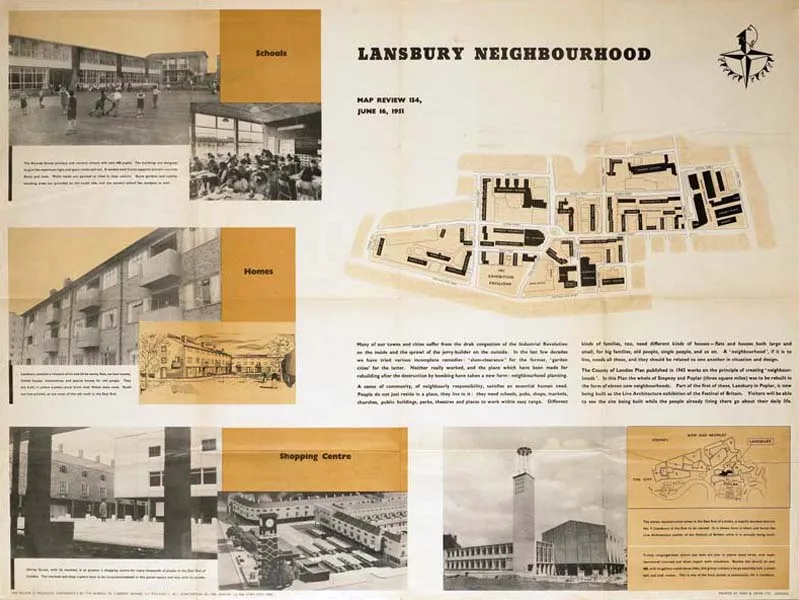
In Britain, the Attlee government’s rapid expansion of social housing was modernist in both philosophy and aesthetic. The Lansbury Estate in Poplar, built as a showcase for the 1951 Festival of Britain, was explicitly designed as a demonstration that working-class housing could be planned, humane, and visually coherent — that council tenants deserved design, not just shelter. The Festival of Britain itself was a piece of applied modernism: the conviction that contemporary design could function as social optimism.
In the United States, the postwar boom produced something more complicated. The new suburban middle class had money but no design tradition — no furniture inherited from grandparents, no accumulated accumulation of objects. They were, in a quite literal sense, a market for a new design culture. And the Eameses, George Nelson at Herman Miller, Knoll under Hans and Florence Knoll, and a network of manufacturers who had spent the war years working with aluminium, fibreglass, and bent plywood, had the objects to supply it.
Across what was then called the Third World, the story was different again — and it begins with a different kind of dislocation. The Second World War had not only rebuilt Europe and created the American middle class; it had fatally weakened the European empires that had organised much of the rest of the world for the previous two centuries. Britain, exhausted and near-bankrupt by 1945, began a long withdrawal from its colonial territories that would see dozens of new nations established between 1947 and the mid-1960s. The question of what those nations would look like — literally, architecturally — was live and urgent. In West Africa in particular, newly independent governments found in modernism an idiom that felt neither colonial nor nostalgic. It was a style that had no local associations with the old power, that was explicitly forward-looking, and that could be adapted to specific conditions without borrowing the aesthetic vocabulary of the people who had just left.
The philosophy in practice
The designers who defined mid-century modernism shared a set of convictions that were philosophically coherent, even when they diverged in practice.
Charles and Ray Eames articulated it most explicitly: the goal was to get ‘the most of the best to the greatest number of people for the least.’ This was not marketing copy. It was a statement of intent that shaped every production decision they made. When the Eames fibreglass shell chair proved more expensive to manufacture than anticipated, they lobbied Herman Miller to absorb the cost rather than raise the retail price.
In West Africa, the practical expression of modernism took a specifically adapted form. The British architects Maxwell Fry and Jane Drew, working in the Gold Coast and Nigeria in the late 1940s and 1950s, developed what became known as Tropical Modernism: the clean lines and functional logic of the International Style reworked for hot, humid climates through deep overhangs, adjustable slats, and open courtyards designed to promote cross-ventilation rather than trap heat. When Ghana’s first president, Kwame Nkrumah, championed this style after independence in 1957, he was doing something deliberate — using modernism not as an aesthetic preference but as a statement of national intent. The Kwame Nkrumah University of Science and Technology in Kumasi, the Kenyatta International Conference Centre in Nairobi, the sweeping modernist skyline that earned Abidjan the nickname “the little Manhattan of West Africa” — these were architecture as argument, built proof that the new nations were not looking backwards. Newly independent governments drew architects from Scandinavia, Eastern Europe, and Israel, not only from their former colonial powers. The internationalism was itself the point.
In Scandinavia — and Danish design in particular — the argument was expressed less explicitly but no less seriously. Arne Jacobsen’s Series 7 chair of 1955, which remains the best-selling chair in the history of furniture, was engineered specifically for volume production. Hans Wegner, the most influential figure in Danish furniture of the period, believed that a chair was only finished when it had been reduced to its essential elements, and that the reduction itself was a form of honesty. The Wishbone chair, designed in 1949 and still produced by Carl Hansen & Søn today, uses a woven paper cord seat not as a stylistic flourish but because woven cord is durable, cheap to produce, and comfortable.
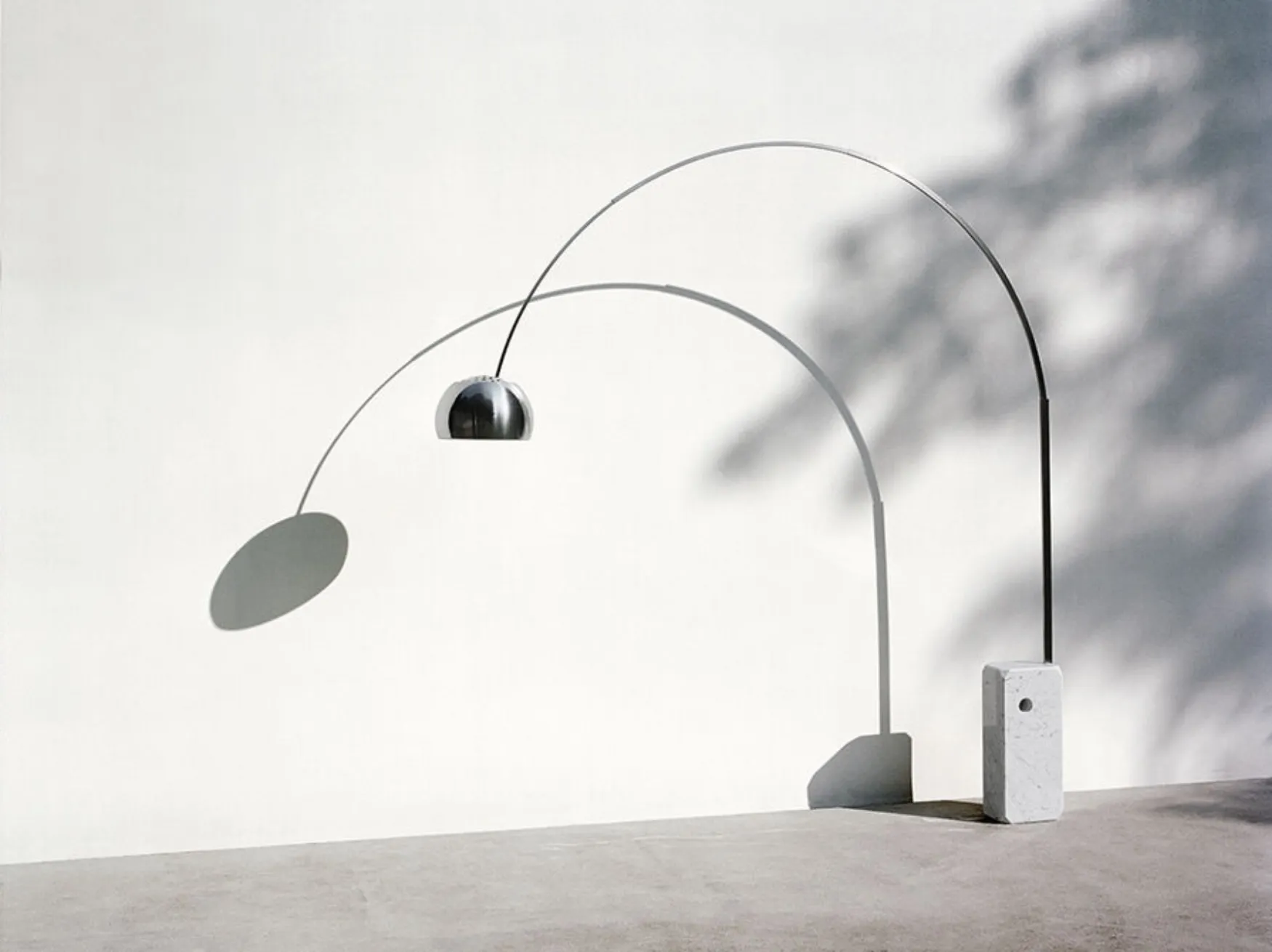
Italian design of the same period took a different route to the same destination. Achille Castiglioni’s Arco floor lamp of 1962 — a 2.5-metre marble-base arc of stainless steel — solved a specific domestic problem (how to light a dining table from above without running cables through the ceiling) using industrial materials that were available and, crucially, cheap. The marble base was not a luxury detail but a functional one: it was the cheapest way to provide counterbalance to a two-and-a-half-metre arm. Castiglioni designed it so that two people could carry it by feeding a broomstick through a hole drilled in the marble. We looked at it in detail in our Object study of the Arco lamp.
Isamu Noguchi’s coffee table of 1948 — the glass top supported by two interlocking curved wooden legs — used a form derived from sculpture and produced it via a manufacturing process that required almost no skilled labour. The legs are injection-moulded and assemble without tools. The whole object is a demonstration that the boundary between craft and industry was a commercial fiction.
The legs of the Noguchi coffee table are injection-moulded and assemble without tools. The whole object is a demonstration that the boundary between craft and industry was a commercial fiction.
What the objects actually share
There is a set of formal properties that runs through mid-century modern design consistently enough to be called a philosophy of making, rather than just a set of shared tastes.
Decoration is absent not because decorative impulses were forbidden but because the objects were designed to find their visual interest in structure. The tapered leg is not ornament — it is the structural response to a leg that needs to carry load without adding visual weight. The fibreglass shell of the Eames chair curves where it curves because the curve distributes pressure across the sitting surface; the aesthetic pleasure follows from the structural logic, not the other way around.
Materials are honest in the sense that they are not disguised as something else. Walnut is walnut, not walnut veneer over chipboard. Brass is brass, not brass plate over cheap steel. When plastic appears — and in mid-century modern design it appears often, and unapologetically — it is plastic, not an imitation of a more traditional material.
The relationship between interior and exterior, particularly in architecture, is treated as a design problem rather than a convention. The large window is not a feature; it is an argument about the relationship between a domestic interior and the landscape it sits in. Wright’s Fallingwater, completed in 1939, takes this argument to an extreme — the house is built over a waterfall, partly to make the point that a well-designed domestic environment should acknowledge its natural context rather than screen it out.
Scale is calibrated for how people actually live. The low platform furniture of the period — sideboards, sofas, beds — brings the eye down, makes rooms read as wider, and reduces the Victorian impulse to fill vertical space with furniture. It is a spatial argument as much as an aesthetic one.
What the movement costs now, and why
The Eames fibreglass shell chair that sold for $19.95 in 1950 now costs £950 through Vitra, the Swiss company that holds the European manufacturing licence. An authentic Noguchi coffee table — produced under licence by Herman Miller — starts at around £2,300 in the UK. The Arco floor lamp, manufactured by Flos, costs £2,350. Louis Weisdorf’s Multi-Lite pendant, produced by Gubi, is available from around £350 for the smallest version.
The movement that set out to put considered design within reach of ordinary incomes has become, at the level of its canonical objects, a luxury category. The irony is not lost on the companies that manufacture these pieces — Vitra, Herman Miller, Knoll, Flos, Carl Hansen & Søn — which tend to explain the prices in terms of materials quality, production ethics, and the ongoing payment of licensing fees to designers’ estates.
These explanations are not dishonest. A Vitra Eames chair is made from virgin fibreglass rather than recycled material, assembled in Switzerland, and genuinely constructed to last several decades. The licence fees fund the Eames Foundation, which preserves and publishes the Eameses’ archive. But the prices are also a function of brand positioning: these objects have become status signals, and the market has priced them accordingly. The £19.95 chair now costs close to the equivalent of a month’s rent.
The secondary market — eBay, Vinterior, specialist dealers — offers authentic vintage pieces at prices that range from genuinely reasonable (an original Robin Day Polypropylene chair for £40) to speculative (an Eames DSW chair in rare colour ways go for £4,000 or more). The line between ‘vintage’ and ‘worn’ is a matter of condition and, increasingly, of provenance documentation.
Replicas, and pieces inspired by the originals, occupy a different category entirely, and the design world’s attitude to them is more complicated than its public rhetoric suggests. While the Eames shell chair is still under copyright in Europe, the US and the UK, Eames-style variations abound. The replica market is large, openly traded, and, for objects this widely copied, arguably a form of the democratisation the Eameses were originally after.
What you are actually buying
There is a version of engagement with mid-century modernism that treats it as a set of objects to acquire — specifically, the right objects, from the right manufacturers, at prices that confirm the seriousness of the commitment. This is a legitimate approach, and if the Vitra Eames chair represents what a well-made chair should cost over a forty-year lifespan, the maths is not as alarming as the sticker price suggests.
But there is another version that takes the philosophy rather than the canon as the point of entry. If the Eameses believed that mass production could make genuinely considered design accessible to people who could not pay for hand-craftsmanship, then the correct way to honour them is not necessarily to spend £695 on a licensed reproduction of a chair they designed to sell for twenty dollars. It might be to look at the broader market — the Danish flatpack brands that continue the Scandinavian tradition, the contemporary Italian manufacturers working in the same material honesty, the vintage market where the philosophy and the object can sometimes be found together at a price that would have made Charles Eames nod.
The mid-century modern aesthetic has been so widely absorbed into contemporary design that its influence is now difficult to separate from what contemporary design simply looks like. The tapered leg appears on furniture sold in supermarkets. The walnut veneer sideboard is a staple of every high-street homewares chain. The form has migrated downmarket in precisely the way the movement’s founders hoped it would.
The philosophy — that beauty is not a luxury, that industrial production is not inherently degrading, that the objects people live with every day are worth thinking hard about — has aged considerably better than most of the twentieth century’s other optimisms. That is not a small thing.
If you want to go further — the best single-volume reference on the period is Dominic Bradbury’s Mid-Century Modern Design: A Complete Sourcebook, which covers furniture, lighting, ceramics, and architecture in one well-illustrated volume. For the sofas the movement produced, we looked at what three price tiers actually get you.